You blink, and just like that… it’s been 4 months since my last blog! After a steady summer of Livadata content, including the launch of my YouTube channel, I found myself in one of those busy periods where life and the day job just has to come first for a while. No complaints, though: my day job is a pretty awesome one, and I’ve spent the past few months working on some genuinely exciting projects with my team. Power BI? Obviously. Agentic Development? You betcha. Fabric? But of course…
So with that in mind, here are five thoughts from the last few months of being fully immersed in all things Data & AI. Enjoy!
Self-Service in the Fabric era
I recently took some time to rework my 2023 “Pyramid of Self-Service” (which I covered in a talk you can find here). The demand for conversational analytics is taking off and organisations are beginning to work out what Fabric usage looks like in a federated Power BI platform. It felt like time to redefine how we measure the depth of self-service.
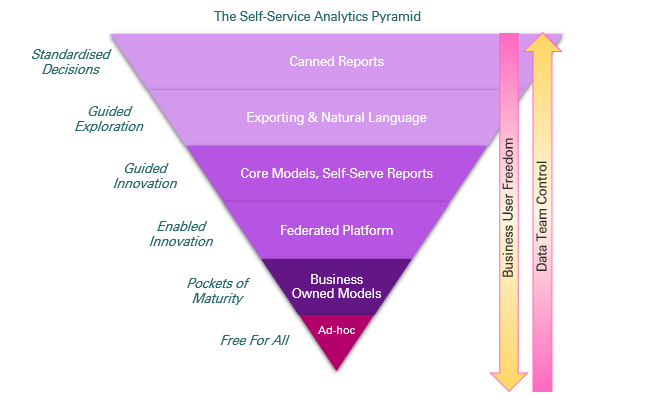
I’ll share more on that soon, but for now these thoughts are key:
Self-service <> maturity ladder. The most mature organisations will utilise multiple tiers of self-service in different scenarios. It’s about having a considered approach for the right group of people or content, rather than a North Star goal to have the entire organisation self-serving conversational analytics. So no… you won’t get any “dashboards are dead” chat here from me I fear!
Enabled Innovation <> Guided Innovation. When many organisations talk to me about aiming for a Federated Data Operating Model, particularly where it comes to BI, they are looking to reduce the onus on the central data teams to serve the business with insight. This is a great strategy to reduce bottleneck that slows the flow of data into real insight, but consider this: do you have a business full of innovators who want to build without blockers, or do you have a business crying out for insight and you don’t know how to get it to them? Turning on Power BI, setting up a Teams channel called ‘PBI Centre of Excellence,’ and fiddling with tenant settings does not create a federated platform. If you want to truly foster innovation in your organisation, you must assess the true demand and skillset in your business before you focus your efforts on delivering models people can use versus truly delivering a governed and well monitored (and supported!) platform people thrive in.
Many ‘Fabric strategies’ are still just licensing conversations
As we close out the year of the great P to F SKU renewals, more people than ever were ready to talk about their Fabric and Power BI licensing models. For some organisations, Fabric = Power BI, and their data platform lives in other tech stacks. For these organisations, it’s been a case of assessing which F SKU would meet their needs. Whether the P SKU existed to grant free licenses to report consumers, or to raise those pesky model size limits, it’s an exercise many had to evaluate. For organisations opting for the Fabric route, or less mature in their data platform and more inclined to experiment, the renewal became the big push to get moving.
What I would say is that in those scenarios where a renewal triggered the conversation of “how do we do Fabric?”, I hear more of the economics of the challenge than of the story. “Do we need a separate capacity for Dev?” and “Should we split the capacities between domains” dominated conversations more than “What do we want to achieve with Fabric? Who do we want to use it? Which business problems should we look to solve first?”
I’m all for planning ahead. Better to consider than to charge boldly into the unknown, but I guess my point here is to say: before you get lost in wondering what a Fabric domain actually does, consider if you have connected it back to the ‘why’. Set your goal for the problems you want to solve with the technology, and let that guide the technical decisions you make from there.
Fabric doesn’t replace Power BI Fundamentals: it exposes the lack of them
At times last year, it felt like many teams paused Power BI innovation, governance or adoption plans in order to “figure out how to do Fabric” first. Plans for conversational analytics, optimisation of workspaces and modernisation of model design and reporting seems to go on hold as some teams scramble to feel on top of their new tech stack.
Any organisation looking to refactor a significant Power BI estate onto a new data platform cannot underestimate the importance of modernising their semantic models and overall health of their reporting ecosystem in the process. When I hear the words “lift and shift” during a scoping exercise, I can’t help but sweat a little at the concept of years of Power Query sticky plasters, spaghetti schemas with “just one more table”, and endless bookmarks being dragged onto a shiny new Fabric platform. “But it’s been running for years? Why is it a problem now?”
Import models and isolated Power BI models allowed a lot of sins to hide:
- Slow refreshes? Throw more capacity at it.
- Bloated models? Users waited a bit longer, but it still worked.
- Logic scattered across 20 pbix files? No one noticed until a refresh broke.
Fabric exposes this because it moves BI closer to an engineering-grade platform where performance, lineage, shared data, and governance matter. The scaffolding that hid the mess has been removed.
So please, keep this Power BI fangirl happy and make the time to intentionally design your semantic models for the modern age while rolling out Fabric… or any data platform for that matter!
Agentic BI isn’t hype… get ready for conversational development
The axis of the BI world shifted a little last summer when Rui Romano’s Agentic BI repo hit the internet. I have always been an advocate of keeping Power BI simple. Don’t turn it into a black box; keep it accessible, and if you find yourself needing to “hack” it to keep that one niche stakeholder happy… I promise there is a way to manage it. (The feature, that is… but sometimes the stakeholder!)
That being said, the rate at which AI models are evolving, and the hard work from the Power BI team to “harden” Power BI Desktop and advance PBIR capability has finally given us the bridge between traditionalists like myself, and the “Pro” Power BI community (who in my team, I call my mad scientists). We’re seeing some fantastic results in our work in Agentic BI, and utilising the new Power BI MCP server to assess how we can accelerate and scale our standards. The trick is to not see it as a monolith, but a suite of entry points you can choose where to start. At a minimum, utilising Agentic BI to QA and optimise allows scaling teams to enforce standards at a manageable rate.
I also find that as M365 Copilot has become for many the companion working alongside us, taking notes in our meetings and reminding us of actions while we remain in the driving seat, the same can be said of Agentic BI while modelling. If I talk to a stakeholder about their reporting requirements, I will start to see a star schema take shape in my head. When I take those same design conversations to an agent, I’m still driving, but the agent is rapidly documenting my mad thoughts in real time. Instead of an image in my head I have to make time to document, map to source and visualise, I have a fully documented schema and mapping thanks to my new best friend, MCP.
The best work happens when you stop getting excited about the tech, and get excited about the humans
I’ve been a part of many projects over the last few months since my last blog, but one of the oldest principles still holds true. The most valuable, successful, and enjoyable pieces of work I’ve been involved in of late are the ones that put human demand at the centre. Not the cost of the SKU, or the tech whim of a fangirl like myself, but the impacts that make people’s lives better. One of my favourite projects involves observability of metadata. That may sound like a very dry topic… but the why behind it is a single interface which connects a large data team and helps them function effectively. Before we ask anyone about schemas, slicers or agents, we ask them “Tell me about the part you play in this amazing team. What makes it hard? What does a good day look like?” With that in mind, even the most technical of use cases can become the most insightful and rewarding peeks into human behaviour. Build for humans, and the technology tends to take care of itself.

 Livadata
Leave a comment