
Day two at FabCon for me involved a packed schedule of Power BI sessions. From Demystified Semantic Modelling to a Deep Dive on Prepping your Data for AI with the new Power BI AI Data Schema.
A highlight for me today that I thought deserved a write up of it’s own, was the Women in Data lunch organised by the FabCon team sponsored by Cosmo Consult. A panel of Microsoft powerhouse women – moderated by Rie Merrit.

Kim Manis (CVP, Fabric & Power BI), Priya Sathy (CVP, SQL Databases), and Wangui Mckelvey (CVP, Product Marketing of Analytics) shared their experiences of why they chose to enter the tech space, how they got there and the challenges they’ve faced.
“We don’t say “my husband helps me with things” because that implies it’s my job. He takes his share of the burden and that small shift in language really matters” – Rie
“Don’t assume your manager always knows what you want. You have to tell them.” – Wangui
An audience member asked the question “Many women in leadership of male dominated fields find they have had to ‘act like a man’ in order to progress – assertiveness, aggression, and does the panel relate to that”
I relate to this massively, and do feel like I spent a lot of my career trying to be the loudest in the room, making sure my voice was heard, and adopting those traits we stereotypically deem “masculine traits” like assertiveness.

This is one of the reasons I’ve deliberately leaned into the Livadata pink, the daft Livadata cartoons and pop culture references you’ll see sprinkled through the blog. I’m someone who comes in a very “pink” package, but is known among colleagues for those traits we code as masculine: assertiveness, boldness, and unapologetic self promotion for both myself and my team.
The panel had some great responses to this:
“Don’t be afraid to put yourself out there… and that doesn’t mean you’re aggressive.” – Priya
“It’s hard to be an introvert, and have all the ideas once you leave the room. Don’t let one person be the one who hears all your ideas.” – Wangui
“I often ask myself ‘would a man say this’” – Kim
I then had a chance to ask the panel a question about leading high performing female teams, and supporting women who have been pushing themselves hard for years and now need to manage the balance that comes with success. If you know my team at Dufrain, you’ll know the Microsoft BI Practice is 80% female – which in the data world is pretty crazy! (I make all my hiring decisions jointly with my colleague Colin Gresham who owns the BI Capability for Dufrain… so it’s not bias I promise!)
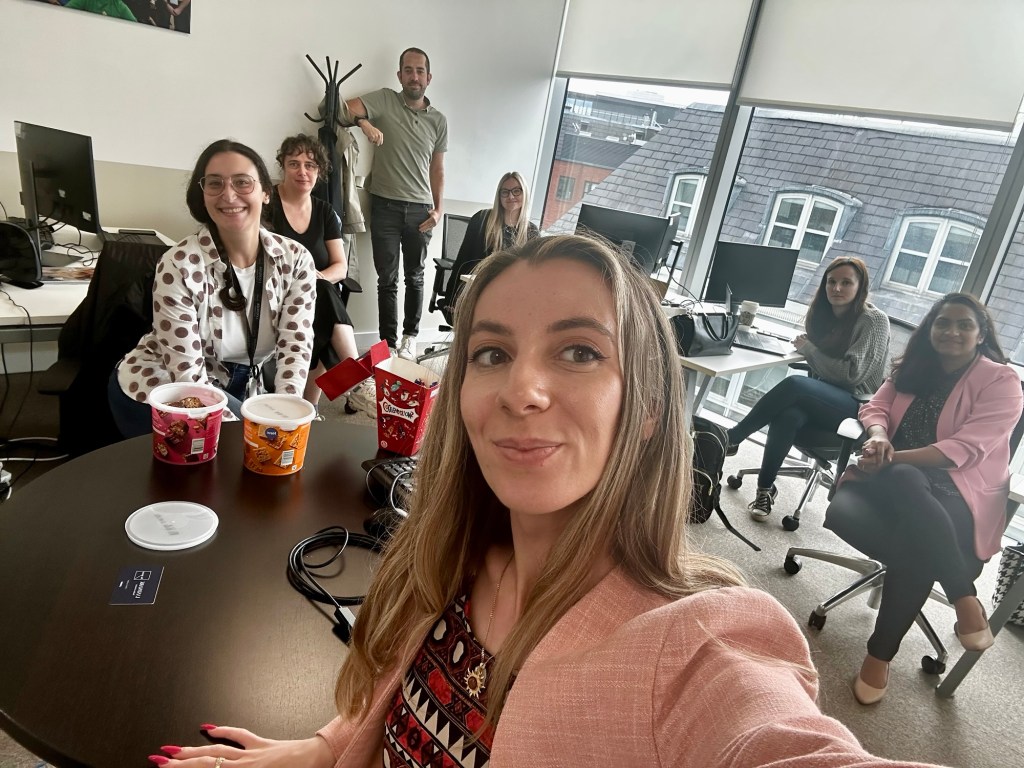
Kim gave some great advice on managing burnout. “Know your triggers, and look after them before it becomes a problem. This is something you mostly learn by screwing up a few times!”
Wangui added “Be people’s cheerleader and encourage them, but also trust them to look after themselves. As long as you’re reminding people to look after themselves, if your team are high performing – let them.”
Rie then added “Make sure you are being what they need to see. Model yourself as you want them to be – take the days off.”
The last question of the day was around managing imposter syndrome, and self promotion.
Priya’s response: “Stop comparing yourself to other people. You know what you’ve done, do you believe it. Recognise within do you feel proud of your own accomplishments. 95% of the time imposter syndrome then goes away.”
Wangui added “Remember you are where you are because someone saw something in you.”
Kim added “Once you remember that most of the time people aren’t thinking about you as much as you think they are!”
I think that last point is so key. I remember going to a fantastic women’s coaching day years ago where this concept was first put on my radar. Humans by nature are self absorbed. We’re all walking around as the main character in our lives. When you realise that in many rooms, you’re nervous about what people think of you, they are nervous about what you think of them… we’re all just worrying about what we think of each other and when you look at it like that it seems ridiculous!
I closed off the lunch with a conversation with the women at my table. “How on earth did you end up with an 80% female team?!”
As a group we noticed the pattern – front end teams are more likely to be female leaning. Many of us were Power BI specialists, or similar design focused disciplines. We noted the pattern of being in very female centric design teams, supported by very male dominated engineering teams. I’ve noticed this often across clients I’ve worked with too. Is it that BI requires that eye for design and business facing “soft skills” that we associate with femininity? That doesn’t mean women can’t or don’t thrive in engineering roles but could it explain some of the patterns we see?
I’ve often wondered if it’s that Power BI is one of the more accessible disciplines in the data world. If, like me, you don’t have an academic background and just fell into data – Power BI is often that entry point that colleagues of mine from admins, analysts, call centre staff and even hospitality backgrounds find themselves pulled to. Engineering however requires that language foundation and I think is a discipline that very much has to be chosen rather than falling into. So I’m less inclined to believe it’s about masculine or feminine skill sets (if there is such a thing), and more that it’s about intentional career selection versus accessibility for those who fall into it.
I speak a lot about how Fabric blurs the lines between disciplines. I’ve seen some of my BI team become very solid Fabric engineers, leaning into the AI space, and leading conversations on platform admin and governance. If Fabric exists to democratise data, then from what I’ve seen in the last 18 months of delivering Fabric for our clients, it also democratises skill sets. The barrier to entry from BI, to Engineering, Architecture and beyond is reduced – and so much like Microsoft’s own diverse product and programme teams, we may soon see that gender balance ripple across the industry also.
 Livadata
Leave a comment